RESEARCH
Translational science at global scale
Building a future where sight-saving innovations reach the patients and populations who need them most
METRIC
Anterior Segment OCT Biomarkers for Improved Measurement of Corneal Infections
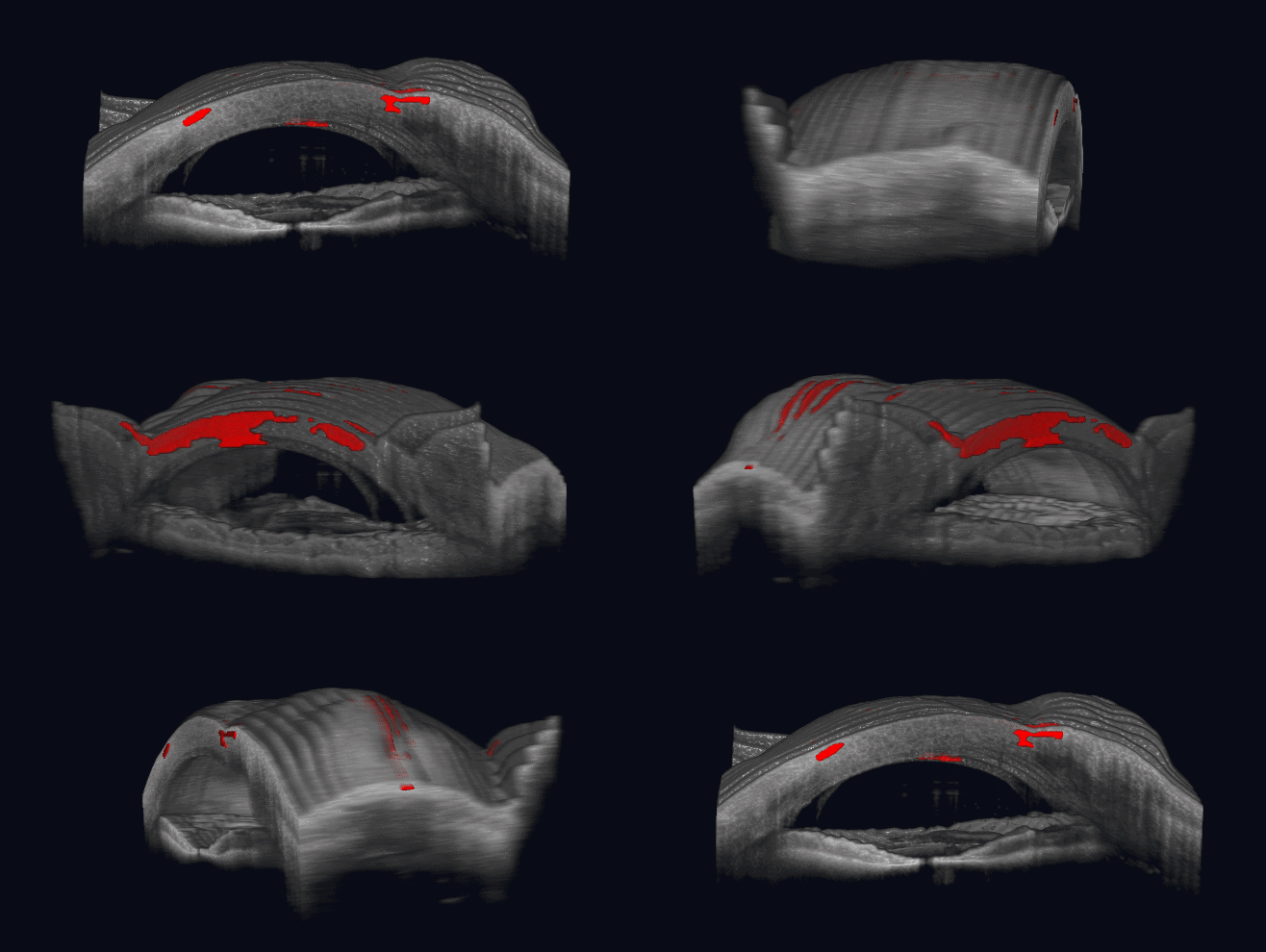
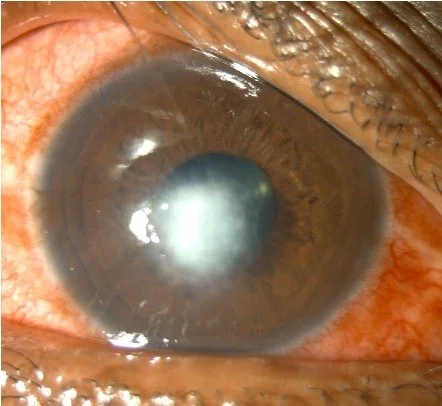
Corneal infections are the leading cause of corneal blindness and the fifth leading cause of blindness worldwide. Despite this burden, developing better treatments has been difficult partly because doctors lack objective, precise ways to measure whether infections are improving or worsening. Traditional eye examinations rely heavily on subjective assessments that can vary between doctors and in some cases can miss important signs of disease altogether. These measurement challenges make it harder to determine whether new treatments actually work. Few new medications for corneal infections have been FDA-approved in recent decades.
Dr. Shekhawat leads METRIC (Measurement and Evaluation of Tomographic Risk in Corneal Infections), a research program using anterior segment optical coherence tomography (ASOCT) to develop quantitative imaging biomarkers (disease measurements) for corneal infections. His work evaluates whether ASOCT can objectively measure disease features that are difficult to characterize by traditional examination, ultimately improving our ability to measure disease severity, measure treatment response, and predict clinical outcomes.
This multidisciplinary work combines clinical epidemiology, quantitative analysis of longitudinal ASOCT imaging, and machine learning. Dr. Shekhawat’s group has used ASOCT to study corneal perforation, infiltrate depth and morphology, endothelial infectious and inflammatory lesions, and hypopyon, including direct comparisons with slit lamp examination. Ongoing work extends these approaches to automated lesion segmentation, textural analysis, three-dimensional volumetric reconstruction, and quantitative measurement of disease evolution over time. The long-term goal is to establish ASOCT as a quantitative biomarker platform for corneal infections, providing objective and reproducible measures of disease severity, prognosis, and treatment response to enable improved clinical care and therapeutic trials.
SELECTED PUBLICATIONS
VISILANT
Bringing sight-saving eye care to those who need it most
Over 2 billion people worldwide live with vision impairment, including over 1 billion with preventable or treatable vision loss. 90% of people with unaddressed vision impairment or blindness live in low- and middle-income countries or regions where severe shortages of eye specialists and barriers to eye care increase risk of blindness. In the United States, many rural patients also lack timely access to diagnosis and treatment because of eye specialist shortages and geographic barriers.
Dr. Shekhawat is Co-Founder and Chief Medical Officer of Visilant (www.visilant.org), a 501(c)(3) nonprofit developing smartphone-based imaging and AI-enabled tele-ophthalmology to bring high-quality eye care to communities with limited access to specialists. Working with leading eye care organizations worldwide, Visilant has screened more than 30,000 patients. Its platform enables healthcare workers with minimal eye examination training to capture diagnostic-quality eye images that can be evaluated remotely by ophthalmologists and, increasingly, using artificial intelligence.
Dr. Shekhawat’s broader telemedicine research evaluates how technology can bring specialist-level eye care closer to where people live. Through randomized trials and prospective studies of community-based screening, remote diagnosis, and referral, his work develops and evaluates new models for connecting rural and underserved patients with high-quality care. The ultimate goal is to ensure that where patients live does not determine whether they receive timely, sight-saving eye care.
SELECTED PUBLICATIONS
IMPACT CONSORTIUM
Bringing world-class science to the front lines of corneal blindness
Johns Hopkins University
Maryland, USA
Aravind Eye Hospital
Pondicherry, India
Shroff Charity Eye Hospital
New Delhi, India
Sadguru Netra Chikitsalaya
Madhya Pradesh, India
The International Multicenter Partnership for Advancing Corneal Transplantation (IMPACT) is a collaborative translational science platform accelerating innovation in diagnostics, therapeutics, and clinical evidence generation for corneal infection, the leading cause of corneal blindness, and corneal transplantation, a sight-restoring treatment that remains understudied and underutilized in many parts of the world.
Founded by Dr. Shekhawat together with leading corneal specialists from major eye care institutions worldwide, IMPACT unites multidisciplinary research teams around a shared translational research pipeline. Current work spans AI-enabled diagnostics and quantitative disease measurement, novel corneal therapeutics moving toward human studies, and large-scale clinical research infrastructure addressing important unanswered questions about optimizing management and outcomes for corneal infections and transplantation. The consortium has enrolled more than 6,000 patients across large-scale prospective studies designed to address major unmet needs in corneal disease. This growing research infrastructure now supports an expanding portfolio of translational and clinical investigation.
IMPACT was designed not simply to conduct individual studies, but to build lasting scientific infrastructure capable of supporting a continuous pipeline of translational research. Research education and mentorship are core components of this effort, alongside promoting scientific leadership and training local investigators in the design, conduct, analysis, and dissemination of clinical research. Together, these partnerships are building a foundation for increasingly ambitious translational studies and, ultimately, clinical trials.
MAKE AN IMPACT